

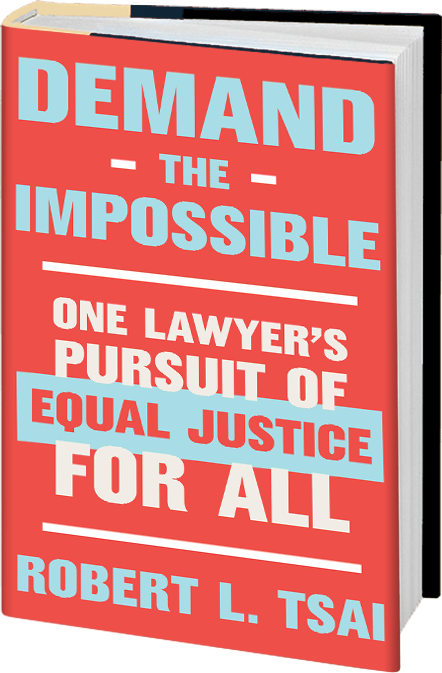
IN BOOKSTORES EVERYWHERE




“As Robert L. Tsai argues persuasively in Demand the Impossible, capital punishment is an affront to equality in every way.”
— Rodger Citron, L.A. Review of Books
“A truly compelling account of how Stephen Bright, one of the nation’s greatest lawyers, devoted his life to demanding justice from the criminal justice system throughout the South…. His career, as told by Tsai, demonstrates how much good a lawyer committed to public justice can do.”
— David Cole, Georgetown Law Faculty’s Best Reads of 2024
“Tsai’s book makes an excellent complement to Bryan Stevenson’s Just Mercy. Provocative, necessary reading.”
— Kirkus Reviews
“Tsai’s tight focus on one lawyer’s uphill battle against inequity is inspiring, especially as it expands outward to track the implications of each victory. Readers interested in criminal justice reform will want to check this out.”
— Publishers Weekly
“An inspiring account of one of our nation’s greatest lawyers, an advocate who has prioritized the poor, the vulnerable, and condemned over money, fame, and the privileged. Steve Bright is a rare legal champion for justice. This book reveals much about this extraordinary man and the critically important human rights he has passionately defended.”
— Bryan Stevenson, Executive Director of Equal Justice Initiative and author of Just Mercy
“As Tsai’s latest deeply moving and sobering book makes so clear, this nation’s moral arc can indeed bend toward justice, but only when we are unfailing in our conviction that it can, and are unflinching in our insistence that it does.”
— Heather Ann Thompson, Pulitzer Prize–winning author of Blood in the Water
“Riveting. Demand the Impossible is a behind-the-scenes thriller that brings to life stories of an exceptional advocate’s against-the-odds legal triumphs in cases of life or death. These victories inspire, but they also shed light on the gross injustices and systemic racism that still infect our legal system. A must-read for everyone who cares about ensuring justice in criminal punishment.”
— Carol Steiker, Henry J. Friendly Professor of Law, Harvard Law School
“This beautifully written story about Stephen Bright’s courageous advocacy shows how one dedicated lawyer can make a difference for his clients and in the legal system. At a time when heroes and inspirational figures are in short supply, Professor Robert Tsai provides a compelling account of how Bright fought for justice in four fascinating cases before the Supreme Court.”
— Erwin Chemerinsky, Dean of UC Berkeley School of Law and author of We the People
How four Supreme Court cases in recent years―all argued and won by one indomitable lawyer―are central to the pursuit of equal justice in America.
Stephen Bright emerged on the scene as a cause lawyer in the early decades of mass incarceration, when inflammatory politics and harsh changes to criminal justice policy were crashing down on the most vulnerable members of society. He dedicated his career to unleashing social change by representing clients that society had long ago discarded, and advocated for all to receive a fair trial.
In Demand the Impossible, Robert L. Tsai traces Bright’s remarkable career to explore the legal ideas that were central to his relentless pursuit of equal justice. For nearly forty years, Bright led the Southern Center for Human Rights, a nonprofit that provided legal aid to incarcerated people and worked to improve conditions within the justice system. He argued four capital cases before the US Supreme Court—and won each one, despite facing an increasingly hostile bench. With each victory, he brought to light how the law itself had become corrupted by the country’s thirst for severe punishment, exposing prosecutorial misconduct, continuing racial inequality, inadequate safeguards for people with intellectual disabilities, and the shameful quality of legal representation for the poor.
Organized around these four major Supreme Court cases, each narrated in vivid and dramatic detail, Tsai’s essential account explores the racism built into the criminal justice system and the incredible advancements one lawyer and his committed allies made for equal rights. An electrifying work of legal history, Demand the Impossible reveals how change can be won in even the most challenging times and how seemingly small victories can go on to have outsized effects.